Data Center Market March Madness: Evaluating Top Markets for the Next Decade of Infrastructure Growth
Every year new markets emerge as potential hubs for data center development.
Some grow rapidly. Others stall out despite early momentum.
The difference usually comes down to a handful of structural factors that determine whether infrastructure can scale.
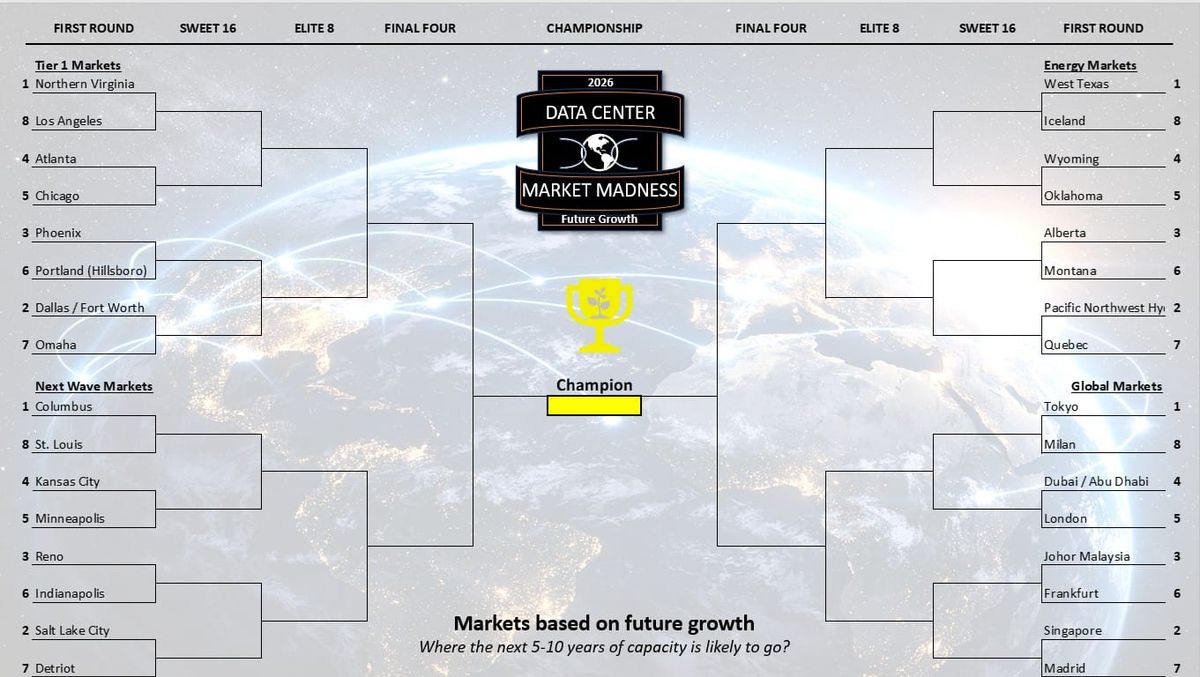
For this year’s Data Center Market March Madness bracket, I evaluated each market using five criteria that consistently determine where data center capacity actually gets built.
The Five Factors That Define a Data Center Market
Use five criteria. Anything more gets too complex.
1. Power Availability
The single biggest constraint in data center development.
Questions to consider:
• How much power is available today?
• Can the grid support large step increases in load?
• How long does it take to energize new capacity?
Example commentary:
In today’s AI infrastructure environment, access to power has become the gating factor for many new builds.
2. Scalability
Even if power exists today, the question becomes:
Can the market support multiple large campuses over time?
Factors include:
• land availability
• zoning and permitting
• utility expansion plans
• substation capacity
3. Connectivity
Data centers are fundamentally network businesses.
Strong markets typically have:
• dense fiber routes
• major internet exchange points
• cloud availability zones
• subsea cable landings (for global hubs)
Connectivity determines how attractive a location is for hyperscalers and network providers.
4. Customer Demand
Markets succeed when real workloads need to be deployed there.
Demand drivers can include:
• hyperscale cloud expansion
• AI compute clusters
• enterprise workloads
• proximity to major population centers
5. Regulatory and Development Risk
Even strong markets can stall if development becomes difficult.
Key considerations:
• permitting timelines
• local political resistance
• water availability
• tax or energy policy changes
Top Markets
Northern Virginia
Power Availability
Large existing capacity but increasingly constrained.
Scalability
Limited greenfield land but strong redevelopment pipeline.
Connectivity
Unmatched global network density.
Customer Demand
Largest hyperscale and enterprise demand hub.
Regulatory Risk
Growing community pushback around power and land use.
Columbus
Power Availability
Strong grid expansion supported by utilities.
Scalability
Large land parcels available for development.
Connectivity
Central Midwest connectivity hub.
Customer Demand
Significant hyperscale investment.
Regulatory Risk
Relatively favorable development environment.
West Texas
Power Availability
Massive generation capacity from wind and gas.
Scalability
Extensive land for large-scale campuses.
Connectivity
Limited fiber density compared to major metros.
Customer Demand
AI and power-intensive workloads potential.
Regulatory Risk
Transmission infrastructure constraints.
Tokyo
Power Availability
Stable but expensive electricity infrastructure.
Scalability
Limited land availability.
Connectivity
Major Asia-Pacific connectivity hub.
Customer Demand
Large enterprise and hyperscale demand.
Regulatory Risk
High construction and development costs.
"The content is based on public information and personal analysis. This is not financial or investment advice."