When Data Centers Dreamed Big
January 7, 2026
Before AI, before GPUs pulling more power than small towns, and before data centers became front-page news, the industry was already experimenting.
These ideas didn’t come from today’s AI boom.
They came from an earlier era when the challenge was efficiency, reliability, and scale, not 100-megawatt clusters.
Here’s how it unfolded.
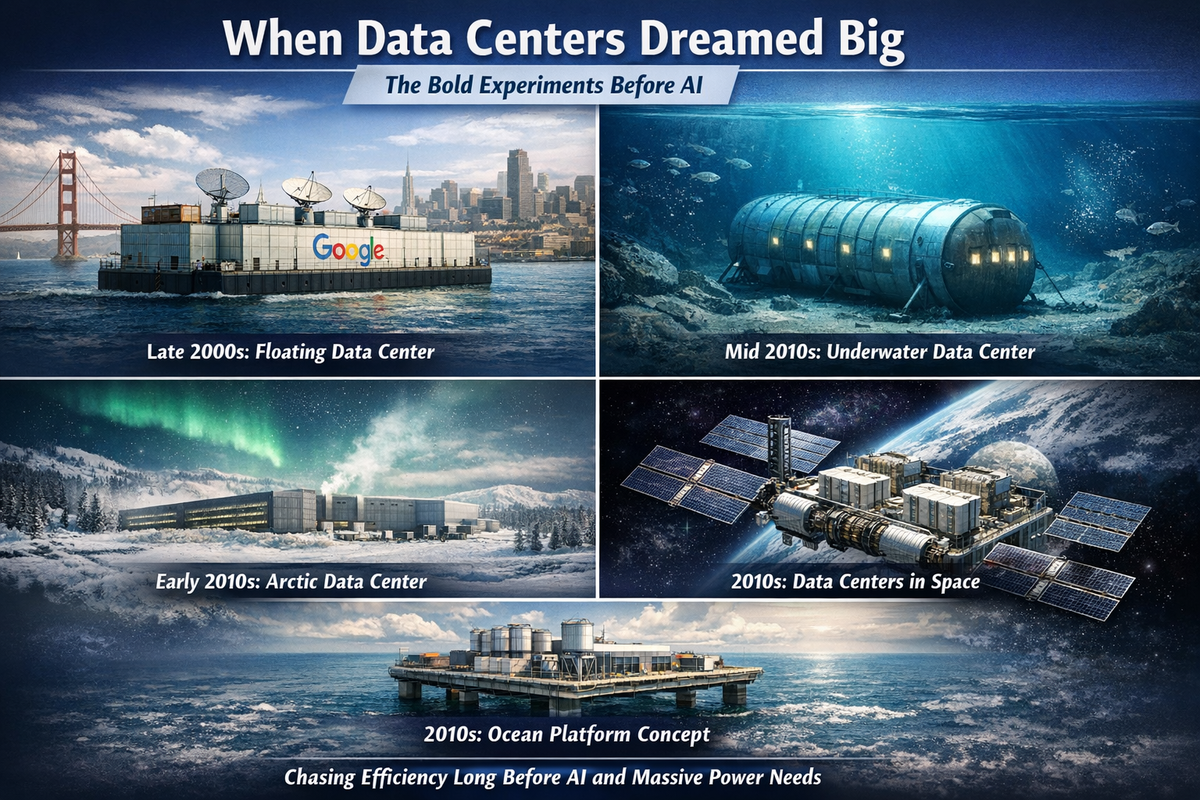
Late 2000s (2007–2010): The Floating Data Center Era
Around the late 2000s, rumors emerged that Google was exploring a floating data center concept in **San Francisco Bay.
This was pre-AI, pre-cloud explosion.
The problem they were trying to solve:
- Traditional cooling was expensive
- Servers were getting denser
- Power efficiency mattered more than raw scale
The thinking was simple:
Cold ocean water could cool servers more efficiently than mechanical chillers.
Why it didn’t scale:
- Marine environments destroy equipment
- Permitting and security were complex
- The economics didn’t beat land-based builds
What it unlocked:
This era planted the seed for liquid cooling, heat reuse, and thinking beyond air cooling long before AI forced the issue.
Early to Mid-2010s (2015–2020): Underwater Experiments
Fast forward a few years and the industry got bolder.
Microsoft Project Natick launched in the mid-2010s, when:
- Cloud adoption was rising
- AI was still niche
- Power densities were modest by today’s standards
Microsoft placed a sealed data center capsule on the ocean floor.
The goal:
- Eliminate cooling energy
- Reduce human error
- Test long-term reliability
The surprising result:
Servers actually failed less often underwater.
Why it stopped:
- Maintenance was extremely difficult
- Scaling was slow
- Repairs required lifting entire units
What it unlocked:
This project influenced today’s sealed environments, automation, and reliability standards that modern AI facilities depend on.
Early 2010s: Chasing Cold on Land
At the same time, companies looked north.
Facebook built major data centers in Luleå starting in the early 2010s.
This was still before AI workloads dominated.
The bet:
- Cold air could replace mechanical cooling
- Renewable power could lower costs
- Geography could be an advantage
This one worked, but with limits:
- Cold helps, but power still rules
- Fiber connectivity still matters
- You can’t put everything in remote places
What it unlocked:
This shaped today’s thinking around site selection, climate awareness, and sustainability long before AI made power the headline constraint.
2010s Thought Experiments: Data Centers in Space
During this same period, engineers and futurists floated ideas for orbital data centers.
This wasn’t science fiction hype. It was a serious design exercise.
The theory:
- Unlimited solar energy
- Infinite cold
- No land or zoning issues
The reality:
- Launch costs erased savings
- Repairs were impractical
- Latency made most workloads unusable
What it unlocked:
A deeper understanding that proximity, latency, and operability matter more than perfect environmental conditions.
The Critical Context: This Was All Before AI
None of these designs were built for today’s world.
At the time:
- Racks were lighter
- Power densities were lower
- Cooling loads were manageable
- Data centers weren’t competing with cities for electricity
AI changed everything.
Today’s constraints:
- Massive power draw
- Extreme heat densities
- Grid interconnection delays
- Community and regulatory scrutiny
The wild ideas of the past weren’t designed for this scale.
Why These “Failures” Still Matter
These experiments weren’t mistakes. They were rehearsals.
They taught the industry:
- How to manage heat differently
- How to design for reliability without humans
- How location, power, and cooling interact
- Where bold ideas break under real-world constraints
Modern AI data centers may look ordinary from the outside, but inside they carry lessons from barges, oceans, Arctic air, and even space.
The Big Takeaway
Innovation doesn’t always survive the moment it’s created for.
But it prepares you for the moment you didn’t see coming.
Before AI turned data centers into power-hungry factories, the industry tested the edges of physics and geography.
Those ideas didn’t win the decade.
But they made today’s AI era possible.
“The content is based on public information and personal analysis. This is not financial or investment advice.”