How Snowstorms Disrupt Daily Life but Leave the Internet Standing
January 28, 2026
Last weekend’s snowstorm across the Northeast was a familiar kind of chaos.
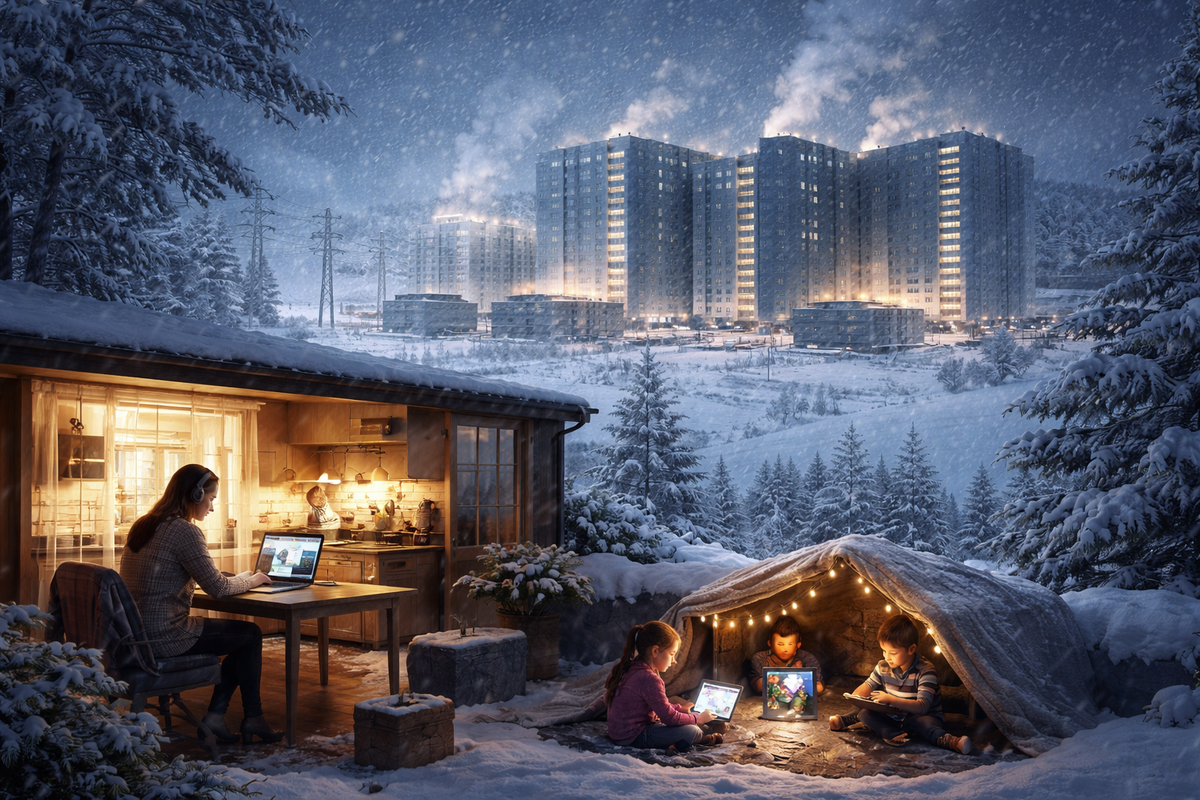
Roads closed. Flights canceled. Trees heavy with ice snapping onto power lines. In some states, hundreds of thousands of people lost electricity. For many families, that meant dark kitchens, cold houses, and phones slowly dying on the counter.
But something else quietly didn’t stop.
The internet.
Kids still logged into virtual classrooms or, in many cases, streamed lessons that had been recorded because school buildings were closed. Parents still joined work calls from home. And for households juggling both, screens became more than entertainment. They became a way to keep kids occupied while adults tried to get through the workday.
When schools close unexpectedly, life does not pause. Deadlines still exist. Meetings still happen. Parents still have to work, and kids still need to be taught, distracted, or at least safely entertained.
For all the disruption on the ground, the digital world stayed mostly intact.
That is not luck. And it is not magic.
It is data center redundancy at work.
Why power outages matter more now than ever
Twenty years ago, losing power meant inconvenience. Today, it means disconnection.
School is no longer just a building. Work is no longer just an office. Entertainment is no longer optional background noise. It is often the glue that keeps a stressful day from falling apart.
Banking, healthcare, logistics, and public safety all rely on systems that assume connectivity is always on. And during storms, demand for these services often increases, not decreases.
That is why data centers are designed under a very different set of assumptions than homes or office buildings.
They are built on the belief that something will go wrong.
Redundancy is not a buzzword, it is a philosophy
At its simplest, a data center is a building full of computers. But those computers support everything from video calls to school portals and streaming platforms that parents quietly rely on when weather shuts everything down.
Failure is not an option, so redundancy is layered into every critical system.
Think of it like this.
Your house has one power line coming in. A data center has multiple independent feeds from the grid. If one fails, another is already live.
If the grid goes down entirely, batteries immediately take over. Not after a delay. Instantly. These batteries are not there to run the building for days. They are there to bridge the gap.
That gap is measured in seconds.
While the batteries are doing their job, backup generators start. These are industrial scale machines, often capable of powering an entire small town. Once running, they can supply electricity indefinitely as long as fuel keeps coming.
Fuel is planned years in advance
Data centers do not just have fuel tanks. They have fuel strategies.
Large operators maintain national contracts with fuel suppliers. These agreements prioritize delivery during emergencies. Routes are planned. Backup vendors are identified. Some sites even have on site fuel that can last days before resupply is needed.
During major storms, when gas stations are closed and deliveries are delayed, fuel trucks still find their way to data centers. Not because they are special, but because the consequences of failure ripple far beyond one building.
We have seen this before
Hurricane Sandy in 2012 was a wake up call.
Much of New York City was dark. Subways flooded. Hospitals evacuated. Entire neighborhoods were without power for days.
But the most resilient data centers stayed online.
Those that failed taught the industry painful lessons. Equipment was moved out of basements. Flood protections were redesigned. Generator placement changed. Fuel access plans were rewritten.
The industry did not forget.
Every major storm since then has reinforced the same reality. Weather events are not rare exceptions anymore. They are part of the operating environment.
What this means for the rest of us
When your internet stays on during a snowstorm, you are seeing the result of thousands of decisions made long before the first snowflake fell.
Decisions to spend more money upfront. To plan for scenarios that might never happen. To assume failure and design around it.
Data centers are not glamorous. Most people will never see inside one. But during moments like last weekend, they quietly prove their value.
When the lights go out, kids are still learning, parents are still working, and households are still functioning.
And increasingly, that difference is not just about convenience. It is about how modern life continues to hold together when everything else stops.
"The content is based on public information and personal analysis. This is not financial or investment advice."