AI Transformation Endures
January 20, 2026
Artificial intelligence is everywhere in today’s headlines, and with the buzz comes a rising chorus of skeptics asking: is AI just another tech bubble waiting to burst? Pundits, investors, and industry insiders seem divided, some warn of inevitable hype and disappointment, while others point to breakthroughs and long-term promise. Amid the noise, it’s easy to miss the bigger picture. This article cuts through the speculation to offer a grounded, insider’s perspective: exploring what history can teach us, how real-world infrastructure is adapting, and why AI’s evolution may be far less fragile than the bubble talk implies. Read on for an in-depth look at why the debate isn’t as simple as hype versus reality and what that means for the future.
Is AI a bubble?
That question keeps coming up lately, usually delivered with the same tone people used in past cycles right before they lumped everything together and called it hype.
From where I sit in the data center world, that framing misses something important.
I’ve watched multiple “bubbles” up close. What people often call a bubble is actually two things colliding at the same time. Short term speculation and long term transformation. They move together early on, then separate.
Speculation can pop.
Transformation usually just slows down.
That distinction matters.
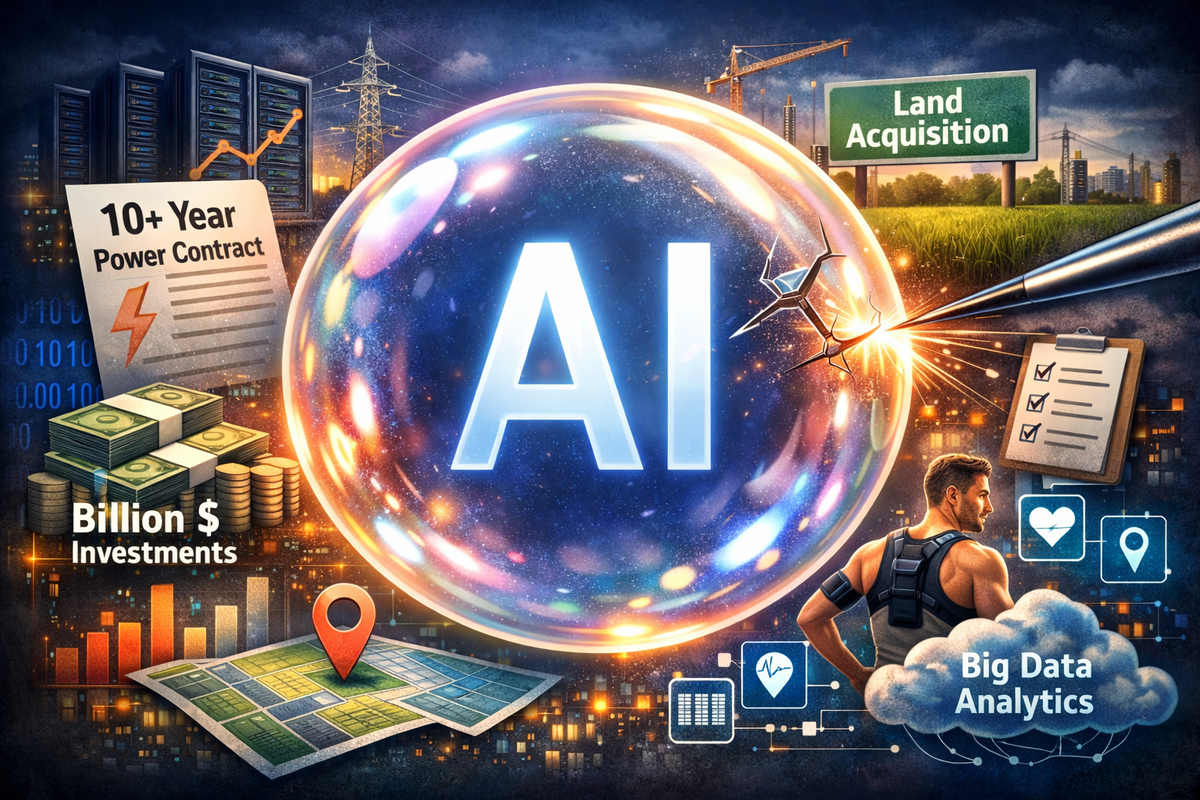
The companies building around AI today are not behaving like short term traders. They are making decade long commitments. Signing 10 to 15 year contracts. Locking in power, land, and infrastructure that only makes sense if usage grows over time. That is not how you behave if you believe demand evaporates after a cycle turns.
We have seen this movie before.
During the dot com era, excess capital chased bad ideas. Many failed. But the internet itself didn’t disappear. It consolidated, matured, and became foundational. The real change survived the hype.
AI feels much closer to that pattern.
To explain why, I often think about data itself and how its role has quietly expanded over the years.
A friend of mine once worked at Catapult, well before “AI” was a buzzword in everyday conversation. Catapult started in Australia in the early 2000s, born out of a partnership between the Australian Institute of Sport and national research centers, with a very specific mission: use data to answer fundamental questions about athlete performance ahead of the Athens Olympics.
The early technology was simple in concept but powerful in impact. Wearable devices collected movement, load, and exertion data so coaches could stop guessing. Training decisions became measurable instead of intuitive.
That purpose never went away. Catapult grew from a local startup into a global sports technology leader, now working with thousands of teams across dozens of sports, from the NFL and EPL to the NCAA. What changed was scale and sophistication. Wearables expanded into full performance ecosystems including athlete management and video analysis. Data moved from being something reviewed after the fact to something that shaped decisions in real time.
That evolution matters because it mirrors what’s happening everywhere else.
We moved from clipboards to spreadsheets.
From spreadsheets to dashboards.
From dashboards to predictive models that adjust as new data comes in.
Each step required more compute, more storage, more infrastructure. Not because it was fashionable, but because once organizations saw better outcomes from data driven decisions, there was no going back.
AI is not replacing data. It is accelerating its usefulness.
And acceleration puts pressure on the physical world. Power grids. Data centers. Networks. These are long lived assets built on long lived assumptions. You don’t pour capital into them for a passing trend.
Does that mean every AI company will succeed? Of course not. Some will fail. Valuations will reset. Growth rates will normalize.
But that is not the same thing as a bubble bursting.
Every major technological shift has an explosive phase followed by a digestion phase. The hype cools. The winners separate from the noise. The technology quietly embeds itself into how work actually gets done.
From where I sit, AI feels like it’s entering that digestion phase.
Slower growth does not mean reversal.
Consolidation does not mean collapse.
History suggests that once society learns to make better decisions with better data, it rarely chooses to go back to guessing.
"The content is based on public information and personal analysis. This is not financial or investment advice."